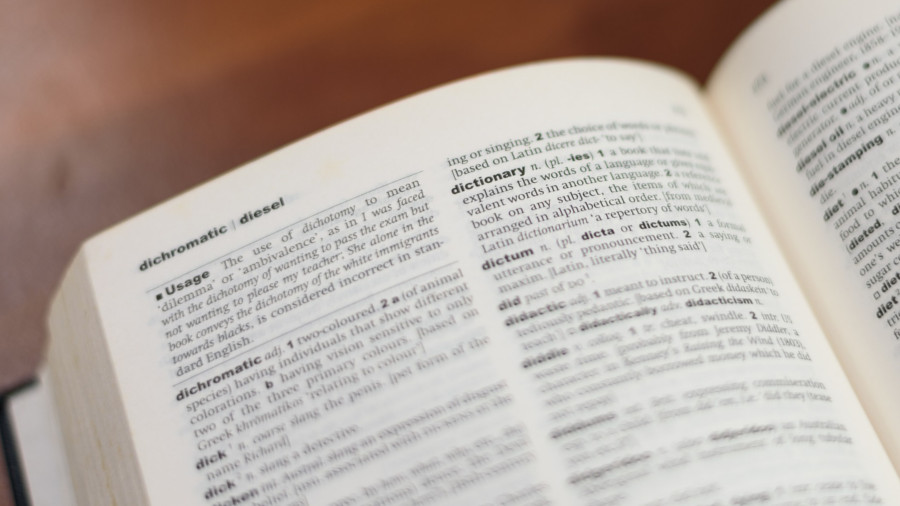
Articles are words we place before a noun Articles therefore belong exclusively to nouns. An article indicates whether the relevant noun is masculine, feminine or neuter.
An article precedes a noun or a word used as a noun, such as an adjective or verb. The article and the word it belongs to do not need to stand directly next to each other. One or more words, such as adjectives and numerals, can appear between them. As a synonym for article, the term sentence article, article or grammatical gender is also used.
Which articles are there?
In Dutch we have two definite articles (de/het) and one indefinite article (een). What is less well known, however, is that geen is also a definite or indefinite article in certain sentence contexts. We also have archaic articles (der/den/des/'s) that are nowadays rarely or never used. The total number of articles was therefore greater than what we use today.
Which article should you use?
For masculine words, feminine words and plurals we use de. For neuter words (words without grammatical gender) we use het. The article een can be placed before any noun.
How do you know whether it is de or het ?
If Dutch is your mother tongue, you learn almost automatically when to use de or het . Native speakers feel this instinctively and automatically choose the correct article. If Dutch is your second language, it can be difficult to know which word is de or het .
When do you use de or het?
There are no general rules regarding the use of articles, but there are a number of de and het rules. Check the handy rules of thumb for de-words and het-words.
Both de and het words
With the following words you can use either de or het , with or without a difference in meaning: aanrecht, aas, account, afval, alert, backoffice, backorder, badge, bal, blik, blog, bracket, channel, cluster, commentaar, contest, cookie, cover, deksel, display, dock, doolhof, eigendom, e-ticket, factsteet, figuur, floppy, format, fret, frontoffice, gadget, hars, idee, image, intermediair, issue, kitten, leaflet, log, lpg, manual, medicijn, midoffice, modem, notebook, omslag, package, paper, pokerface, pond, portal, record, risico, roest, sap, scala, schort, screenshot, seminar, servicepack, sheet, silhouet, singlet, soort, spits, subsidie, supreme court, target, ticket, topic, trial, vlog, vuilnis, vlog, webinar, weblog en whitepaper. Many of these examples are English loanwords.